Dressed for the Boardroom and the Prayer Room: How Arab American Women Are Owning Professional Style
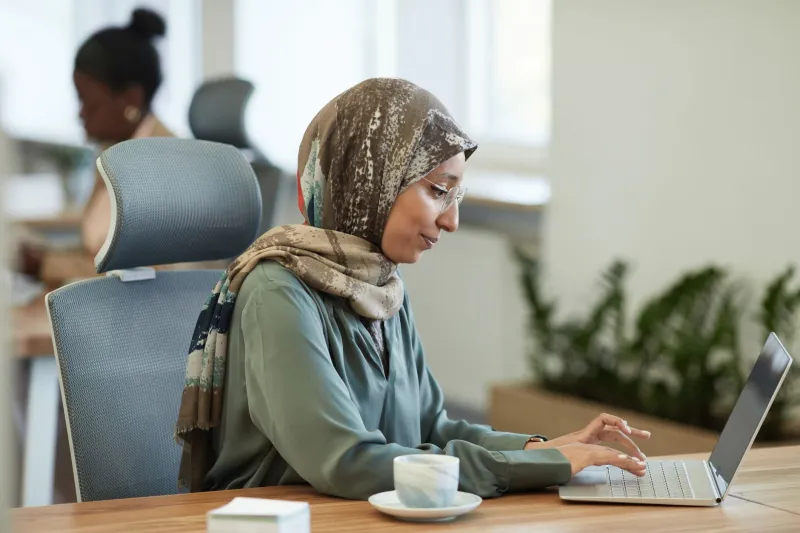
There's a moment Nadia, a 31-year-old corporate attorney in Chicago, knows well. It's the split second when she walks into a deposition room — tailored wide-leg trousers, a structured abaya-cut blazer, silk hijab pinned just so — and watches people recalibrate their assumptions in real time. "They expect one thing," she says, "and I show up as something completely different. That's the whole point."
Across the US, Arab American women in professional fields are navigating a very specific kind of code-switching — not the kind that asks you to shrink yourself, but the kind that demands you show up fully and still play the game. And increasingly, they're doing it with an intentionality around modest workwear that is reshaping what professional style even means.
The Old Rules Were Never Written for Us
Let's be honest: the traditional corporate dress code was not designed with Arab or Muslim women in mind. The classic "power suit" was borrowed from menswear. The "polished professional" aesthetic that dominated HR handbooks for decades was coded with a very specific image — and it wasn't one that left room for a hijab, a longer hemline, or a more covered silhouette.
For years, many Arab American women felt the pressure to either fully assimilate aesthetically or accept being seen as "less professional" by default. Neither option was acceptable. So they built a third path.
Samira, a UX designer at a Bay Area tech company, describes her early career wardrobe as "safe but invisible." She wore neutral colors, avoided anything that felt too cultural, and still felt like she didn't quite fit. "I was trying to dress for their comfort instead of my own confidence," she says. "When I stopped doing that, everything changed — including how I showed up in meetings."
The Modest Workwear Formula That Actually Works
So what does elevated modest workwear look like in practice? The women we spoke to across industries — law, finance, healthcare, and tech — had a few things in common.
Silhouette is everything. Wide-leg trousers, midi skirts with structure, and longline blazers create authority without sacrificing coverage. The key is fit — modest doesn't mean shapeless, and tailoring makes all the difference between looking pulled together and looking like you borrowed someone else's clothes.
Fabric does the heavy lifting. Crepe, ponte, and quality jersey fabrics hold their shape, don't cling, and photograph well on video calls (a non-negotiable in 2024). Linen works beautifully in warmer climates, especially in California and Texas where a lot of our community is concentrated.
The hijab as an accessory, not an afterthought. Women like Hana, a financial analyst in New York, have turned their hijab styling into a signature. "I match my hijab to my blazer lining, or I use it as a pop of color in an otherwise neutral outfit," she explains. "It's the most personal part of my look and it should be intentional."
Modest doesn't mean colorless. Some of the most striking professional looks we've seen in Arab American fashion circles lean into rich jewel tones — deep burgundy, forest green, cobalt — that read as confident and authoritative rather than understated.
Breaking It Down by Industry
Different workplaces have different unwritten rules, and Arab American women are navigating each one differently.
In law and finance, where traditional dress codes still carry weight, the approach tends to be classic with strategic personalization. Think structured blazer sets, quality fabrics, and precise tailoring. The hijab, styled cleanly and pinned neatly, communicates the same attention to detail as a well-knotted tie.
In tech and creative fields, there's more room to experiment. Modest silhouettes in unexpected prints, statement modest dresses paired with minimal sneakers, or a beautifully draped scarf with a relaxed blazer — the language is more flexible, and Arab American women in these spaces are often the ones setting the aesthetic tone for their entire teams.
In healthcare, where scrubs are the uniform, the modest workwear conversation shifts to what happens outside of clinical hours — networking events, conferences, hospital administration meetings. Here, the investment in one or two really well-made modest professional pieces pays off disproportionately.
The Brands Making This Easier
The market is catching up, slowly but meaningfully. Brands like Vela, Niswa Fashion, and Haute Hijab have made it significantly easier to find pieces that work in professional settings without the exhausting hunt through mainstream retailers. Some Arab American women are also turning to tailors — both local and overseas — to get exactly what they need.
And then there's the growing presence of Arab-founded brands on platforms like سوق البنات, where you can actually find pieces designed with this specific lifestyle in mind. The difference between shopping a brand that understands your needs versus one that's retrofitting modest options as an afterthought is immediately obvious in the product quality and design choices.
Redefining 'Professional' Is the Real Work
Ultimately, what Arab American women are doing in professional spaces goes beyond personal style. It's a quiet, persistent argument that professionalism was always a cultural construct — and one that can be reconstructed.
Nadia, our Chicago attorney, puts it simply: "Every time I win a case looking exactly like myself, I'm changing what a lawyer looks like. That matters for the next Arab American girl who walks into a law school orientation and wonders if there's space for her."
There is. And she's going to look incredible.